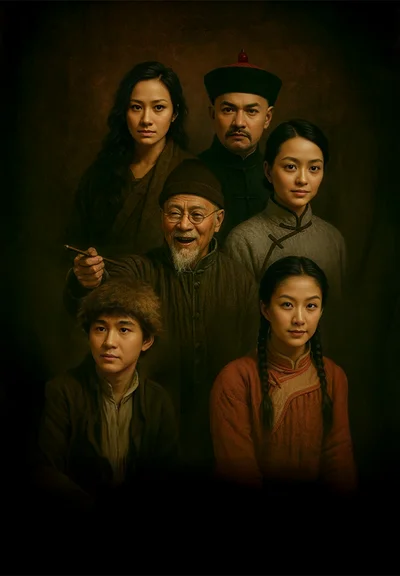
Battle of Wits
Battle of Wits
The show presents a war-torn saga in which rulers, commanders, strategists, fighters, and civilians are repeatedly driven into impossible choices as sieges, pursuits, and open battles close in. At its core, the story turns on a recurring conflict between surrender and resistance, with leaders debating whether survival lies in compromise, evacuation, or holding the line against overwhelming force. In the Liang-centered conflict, a kingdom facing an advancing army places its hopes in a newly arrived strategist, whose authority grows as discipline and coordinated defense become the last barrier against collapse. Yet that defense is morally fraught from the start, as harsh tactics such as poisoning streams and wells create tension even among allies and expose the cost of preserving the city. The siege intensifies through breached gates, collapsing crossings, inner-fortress fighting, and desperate efforts to protect key figures while keeping soldiers and civilians from breaking. A rescue operation eventually turns into a counterattack and produces a declared victory, but the aftermath does not bring peace, only suspicion, delayed judgment, and hints of political reckoning. Elsewhere, fugitives and soldiers struggle through pursuit and river escape, underscoring how survival in this world often depends on deception, endurance, and sheer refusal to surrender. The war also reaches ordinary people directly, as villages are destroyed, families detained, and children seized under the rhetoric of mercy and submission. One mother’s fight to recover her child becomes a personal mirror of the larger conflict, and her bond with a battle-hardened fighter adds an intimate stake to the surrounding violence when she asks him to return from war. At the level of state power, councils and courts repeatedly show that battlefield danger is matched by internal distrust, with rulers and generals arguing over final battles, allied obligations, arming the populace, and who can safely be trusted. Accusations of treason, disputes over custody of royal figures, and the confinement of a strategist after battle reveal that victory and blame are never cleanly separated. The crisis widens further when executions of suspected rebel sympathizers provoke retaliation, turning punishment into fuel for renewed war and deepening the split between authority and resistance. As enemy pressure mounts and command falters, leaders are forced into stark choices between retreat, sacrifice, evacuation, and defending the city to the end. These tensions culminate around a river crossing, where conflicting orders divide the ranks and even duty to the homeland is set against obedience to sovereign authority. Some withdraw while others rally around a vow to keep fighting, making the fracture within the defending side as dangerous as the enemy assault itself. Ceremony and combat then collide as public acclaim for the Maharaja continues even while troops take aim, arrows fly, and commanders search for missing leaders amid chaos. Acts of staying behind, shielding others, and refusing retreat give the show its emotional throughline, suggesting that loyalty is measured less by slogans than by what each person is willing to lose. Across the whole arc, the stakes are both political and deeply personal: the survival of kingdoms and strongholds, the legitimacy of rulers and strategists, and the fate of families caught between military necessity and cruelty. The result is a unified story of war as a test of authority, conscience, and endurance, where every apparent victory carries unresolved human and political cost.
- A
- Story
- telugu