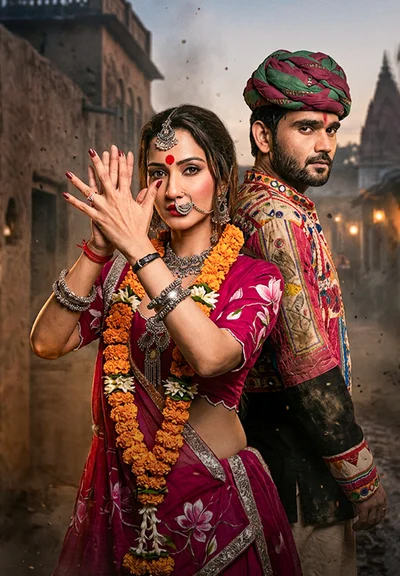
•2026•43 Episodes•4M+
The story centers on Damini and Jai as their relationship is repeatedly tested by public shame, family control, and questions of identity. It begins with Jai traveling to the border with his uncle to find a bride, where marriage is treated like a public contest and his pride pushes him to keep bidding despite warnings. The situation turns scandalous when the woman tied to the marriage is revealed to be a kinnar, and romance quickly becomes a source of humiliation and conflict. Across the early arc, money, status, and social stigma keep overriding personal feeling, and Damini is repeatedly treated as if she can be bought or controlled. Even after marriage, the household and village remain hostile, and Damini fears exposure while Jay tries to defend her dignity. The conflict widens into searches, disappearances, and accusations, with missing money, missing people, and police involvement deepening the crisis. Other figures such as Manjari, Rishi, Swayam, Vikram, and Kamini appear in linked tensions of betrayal, rejection, and attempts to repair past mistakes, but the emotional center keeps returning to Damini’s safety and recognition. Jay’s love for Damini becomes more explicit as he rejects caste and color divisions and insists that she matters more than money. Public declarations of love, however, trigger violence and renewed stigma, showing how fragile their bond is in front of the community. The village women and older relatives intensify the pressure by questioning pregnancy, childlessness, and the legitimacy of the marriage. At one point the panchayat turns the couple’s private life into a public trial and even orders them to be hanged together, making the stakes life-or-death. Their refusal to separate becomes a test of devotion rather than surrender. A Sarpanch then intervenes and argues that Damini’s identity is not wrongdoing, directly challenging the council’s prejudice. His defense forces the elders to reverse the punishment and allow the pair to marry. The council also condemns the violence done to Damini, and the public wedding becomes a symbolic affirmation of her place in the community. Even so, the final movement suggests that acceptance remains fragile, because the story closes with Damini still being urgently called for in a new public setting. Overall, the show tracks a struggle for love, dignity, and social recognition against a world that keeps trying to reduce Damini to stigma or property.
The story centers on Damini and Jai as their relationship is repeatedly tested by public shame, family control, and questions of identity. It begins with Jai traveling to the border with his uncle to find a bride, where marriage is treated like a public contest and his pride pushes him to keep bidding despite warnings. The situation turns scandalous when the woman tied to the marriage is revealed to be a kinnar, and romance quickly becomes a source of humiliation and conflict. Across the early arc, money, status, and social stigma keep overriding personal feeling, and Damini is repeatedly treated as if she can be bought or controlled. Even after marriage, the household and village remain hostile, and Damini fears exposure while Jay tries to defend her dignity. The conflict widens into searches, disappearances, and accusations, with missing money, missing people, and police involvement deepening the crisis. Other figures such as Manjari, Rishi, Swayam, Vikram, and Kamini appear in linked tensions of betrayal, rejection, and attempts to repair past mistakes, but the emotional center keeps returning to Damini’s safety and recognition. Jay’s love for Damini becomes more explicit as he rejects caste and color divisions and insists that she matters more than money. Public declarations of love, however, trigger violence and renewed stigma, showing how fragile their bond is in front of the community. The village women and older relatives intensify the pressure by questioning pregnancy, childlessness, and the legitimacy of the marriage. At one point the panchayat turns the couple’s private life into a public trial and even orders them to be hanged together, making the stakes life-or-death. Their refusal to separate becomes a test of devotion rather than surrender. A Sarpanch then intervenes and argues that Damini’s identity is not wrongdoing, directly challenging the council’s prejudice. His defense forces the elders to reverse the punishment and allow the pair to marry. The council also condemns the violence done to Damini, and the public wedding becomes a symbolic affirmation of her place in the community. Even so, the final movement suggests that acceptance remains fragile, because the story closes with Damini still being urgently called for in a new public setting. Overall, the show tracks a struggle for love, dignity, and social recognition against a world that keeps trying to reduce Damini to stigma or property.
Sacred Marriage: A Love Beyond Gender is a Forbidden Love Series in Hindi, streaming on Kuku TV.
Sacred Marriage: A Love Beyond Gender has 43 episodes, watched over 4M+ times on Kuku TV.
Sacred Marriage: A Love Beyond Gender is available to watch in Hindi on Kuku TV.
Sacred Marriage: A Love Beyond Gender was released in 2026 and is streaming on Kuku TV.
Sacred Marriage: A Love Beyond Gender is rated U/A 16+.
The cast of Sacred Marriage: A Love Beyond Gender includes Satvik Pathak, Astonishing_Lover861E, Esshanya S Maheshwari, Priya Singh, Futuristic_Explorer782w, and Pawan Kumar Gupta.
You can watch Sacred Marriage: A Love Beyond Gender online on Kuku TV or download the Kuku TV app to start playing. Open any episode above to start watching instantly.