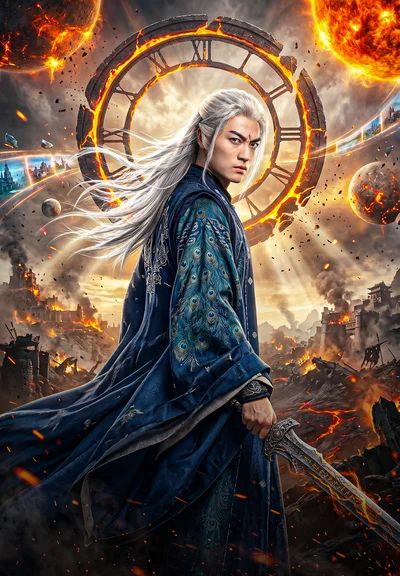
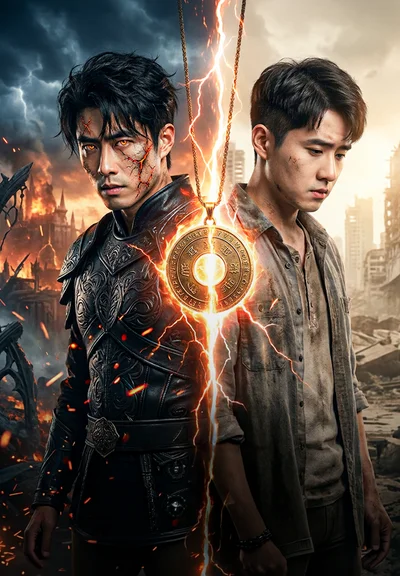
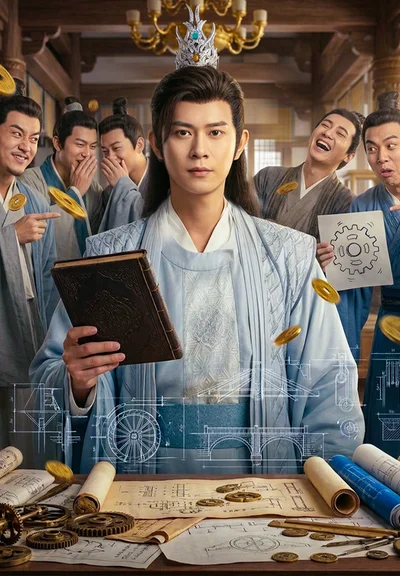
The story opens on a cosmic emergency, with a meteor threatening Earth while four sages and other divine forces struggle to contain it. Against that backdrop, a boy returns after 10,000 years of tapasya and claims power beyond saints, signaling that hidden strength will shape everything that follows. The narrative then moves into village and family conflict, where returning sons are mocked, fathers are arrested or shamed, and ordinary life is disrupted by suspicion and police trouble. Marriage becomes a major fault line, as promises are forgotten, engagements are questioned, and heartbreak follows when family pressure and financial hardship break a hoped-for union. Feng and Xiao’s relationship collapses under that pressure, turning love into humiliation and regret. Yuri and Fang then emerge as a central pair in a much larger public battle over engagement, dignity, and status. Their conflict is repeatedly staged in front of crowds, where accusations, old letters, and claims of betrayal are used as weapons. Yuri insists on exposing the truth and preserving her dignity, while Fang tries to defend his land, his image, and his chance to win her back. A protective chairman also steps in, offering Yuri a different future and adding another layer to the struggle over her life. The drama keeps widening into weddings, temple disputes, and ceremonial showdowns, where even apologies and compensation become public tests of worth. Money becomes a blunt measure of power, especially when huge shagun transfers are announced and verified in front of everyone. These displays do not settle the conflict, but instead deepen the humiliation and force families to choose between pride and practical acceptance. Hidden romantic histories surface as ex-boyfriends, broken promises, and long-buried feuds complicate every public gathering. At the same time, the story repeatedly returns to the idea that status can be overturned by sudden proof of wealth, lineage, or destiny. That pattern expands further into supernatural and divine confrontations, where rebels challenge sacred authority and are met with overwhelming force. In those arcs, pride is punished, false claims are exposed, and hidden powers are revealed through beasts, saints, and celestial rulers. The stakes keep rising from personal shame to family honor, then to cosmic order, as each conflict suggests that no one can rely on appearances alone. By the end, the show has fused romance, revenge, money, and mythology into one escalating struggle over who has the right to love, rule, and be believed.
The story opens on a cosmic emergency, with a meteor threatening Earth while four sages and other divine forces struggle to contain it. Against that backdrop, a boy returns after 10,000 years of tapasya and claims power beyond saints, signaling that hidden strength will shape everything that follows. The narrative then moves into village and family conflict, where returning sons are mocked, fathers are arrested or shamed, and ordinary life is disrupted by suspicion and police trouble. Marriage becomes a major fault line, as promises are forgotten, engagements are questioned, and heartbreak follows when family pressure and financial hardship break a hoped-for union. Feng and Xiao’s relationship collapses under that pressure, turning love into humiliation and regret. Yuri and Fang then emerge as a central pair in a much larger public battle over engagement, dignity, and status. Their conflict is repeatedly staged in front of crowds, where accusations, old letters, and claims of betrayal are used as weapons. Yuri insists on exposing the truth and preserving her dignity, while Fang tries to defend his land, his image, and his chance to win her back. A protective chairman also steps in, offering Yuri a different future and adding another layer to the struggle over her life. The drama keeps widening into weddings, temple disputes, and ceremonial showdowns, where even apologies and compensation become public tests of worth. Money becomes a blunt measure of power, especially when huge shagun transfers are announced and verified in front of everyone. These displays do not settle the conflict, but instead deepen the humiliation and force families to choose between pride and practical acceptance. Hidden romantic histories surface as ex-boyfriends, broken promises, and long-buried feuds complicate every public gathering. At the same time, the story repeatedly returns to the idea that status can be overturned by sudden proof of wealth, lineage, or destiny. That pattern expands further into supernatural and divine confrontations, where rebels challenge sacred authority and are met with overwhelming force. In those arcs, pride is punished, false claims are exposed, and hidden powers are revealed through beasts, saints, and celestial rulers. The stakes keep rising from personal shame to family honor, then to cosmic order, as each conflict suggests that no one can rely on appearances alone. By the end, the show has fused romance, revenge, money, and mythology into one escalating struggle over who has the right to love, rule, and be believed.
Master of Ten Thousand Years is a Mythology Series in Hindi, streaming on Kuku TV.
Master of Ten Thousand Years has 84 episodes, watched over 5M+ times on Kuku TV.
Master of Ten Thousand Years is available to watch in Hindi on Kuku TV.
Master of Ten Thousand Years was released in 2026 and is streaming on Kuku TV.
Master of Ten Thousand Years is rated A.
The cast of Master of Ten Thousand Years includes Manoranjana Ira and Tilak Dubey.
You can watch Master of Ten Thousand Years online on Kuku TV or download the Kuku TV app to start playing. Open any episode above to start watching instantly.