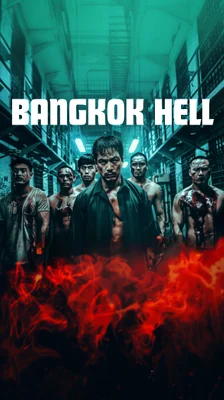
•2025•37 Episodes•45K+
The series opens with a violent ambush on Superintendent Seelan that ends in a catastrophic crash and establishes a public mood of fear and spectacle. A street chase and courtroom scene follows in which Mr. Rawat Sudhikarna is convicted for reckless driving, and that early public violence threads into later sequences. Three years on, nineteen newcomers are marched into a high-security facility run under Superintendent Sila and Chief Warden Moon and are processed under strict anonymity and rule-bound induction. The institution enforces conformity through clinical searches, hard labor and a hierarchy that pushes many toward compliance simply to survive. One vulnerable newcomer is singled out for monitoring and subjected to a brutal initiation in which officers coerce him to claim a hardened criminal identity in exchange for leniency. Corrupt personnel escalate abuses by bargaining reduced punishment for inmates who humiliate and sexually assault the newcomer, and predatory groups like Lust One/Two/Three and the gang Samurai exploit that system. Repeatedly the drama shows how institutional bargains among guards, gang enforcers and desperate prisoners produce new harms and wrenching moral choices. Outside the walls, fast chases, a live reporter, gunfire and a ten-minute tactical countdown expose the spectacle of pursuit and raise suspicion that scenes may be staged for media effect. Parallel threads probe framing and planted evidence when a young detainee insists he was set up and hints at an influential employer or patronage. Inside detention, debates over whether inmates are drugged or genuinely ill, absurdly long sentences and psychiatric containment blur the line between punishment and care. The tension explodes when a manufactured poison nearly kills an inmate named John, and only a timely antidote from the facility doctor—with aid from Ray—prevents catastrophe. That poisoning intensifies fault lines: loyal protectors clash with gangs, on-duty officers dispute duty, and fear of covert experiments or bargains spreads. As escapes and raids unfold, fugitives plead for anonymity and aid while philosophical conversations about sight, inner freedom, karma and erased identity complicate simple narratives of guilt and innocence. Mounting unrest culminates in a massive riot and breakout attempt led by figures such as Arpan, producing detonations, sieges and vehicle chases that split the compound into factions. The public processing of a populist figure, Seela, amid chanting supporters magnifies political pressure and shows how spectacle, patronage and blackmail run alongside carceral cruelty. The arc closes on a public catastrophe in which a witness chooses flight over aid, leaving questions of betrayal, duty, survival and justice unresolved and the larger moral stakes intact.
The series opens with a violent ambush on Superintendent Seelan that ends in a catastrophic crash and establishes a public mood of fear and spectacle. A street chase and courtroom scene follows in which Mr. Rawat Sudhikarna is convicted for reckless driving, and that early public violence threads into later sequences. Three years on, nineteen newcomers are marched into a high-security facility run under Superintendent Sila and Chief Warden Moon and are processed under strict anonymity and rule-bound induction. The institution enforces conformity through clinical searches, hard labor and a hierarchy that pushes many toward compliance simply to survive. One vulnerable newcomer is singled out for monitoring and subjected to a brutal initiation in which officers coerce him to claim a hardened criminal identity in exchange for leniency. Corrupt personnel escalate abuses by bargaining reduced punishment for inmates who humiliate and sexually assault the newcomer, and predatory groups like Lust One/Two/Three and the gang Samurai exploit that system. Repeatedly the drama shows how institutional bargains among guards, gang enforcers and desperate prisoners produce new harms and wrenching moral choices. Outside the walls, fast chases, a live reporter, gunfire and a ten-minute tactical countdown expose the spectacle of pursuit and raise suspicion that scenes may be staged for media effect. Parallel threads probe framing and planted evidence when a young detainee insists he was set up and hints at an influential employer or patronage. Inside detention, debates over whether inmates are drugged or genuinely ill, absurdly long sentences and psychiatric containment blur the line between punishment and care. The tension explodes when a manufactured poison nearly kills an inmate named John, and only a timely antidote from the facility doctor—with aid from Ray—prevents catastrophe. That poisoning intensifies fault lines: loyal protectors clash with gangs, on-duty officers dispute duty, and fear of covert experiments or bargains spreads. As escapes and raids unfold, fugitives plead for anonymity and aid while philosophical conversations about sight, inner freedom, karma and erased identity complicate simple narratives of guilt and innocence. Mounting unrest culminates in a massive riot and breakout attempt led by figures such as Arpan, producing detonations, sieges and vehicle chases that split the compound into factions. The public processing of a populist figure, Seela, amid chanting supporters magnifies political pressure and shows how spectacle, patronage and blackmail run alongside carceral cruelty. The arc closes on a public catastrophe in which a witness chooses flight over aid, leaving questions of betrayal, duty, survival and justice unresolved and the larger moral stakes intact.
Bangkok Hell is a Crime Story in Kannada, streaming on Kuku TV.
Bangkok Hell has 37 episodes, watched over 45K+ times on Kuku TV.
Bangkok Hell is available to watch in Kannada on Kuku TV.
Bangkok Hell was released in 2025 and is streaming on Kuku TV.
Bangkok Hell is rated A.
The cast of Bangkok Hell includes Praveen.
You can watch Bangkok Hell online on Kuku TV or download the Kuku TV app to start playing. Open any episode above to start watching instantly.