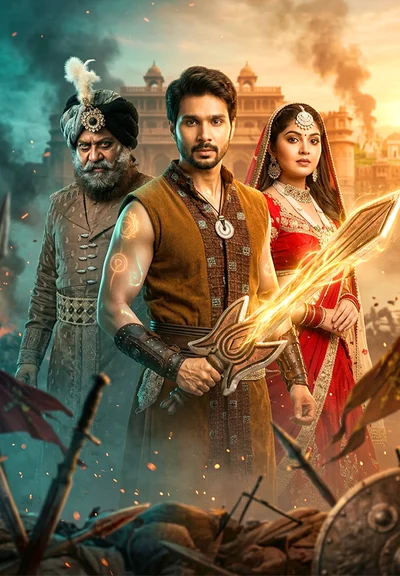
The story begins in a spiritual training world where students are pushed to awaken hidden abilities, but prejudice and hierarchy repeatedly block those who show promise. A fire at an animal shelter forces an urgent use of forbidden knowledge, and the student who helps is praised only briefly before being condemned as untouchable and accused of crossing boundaries he was never meant to cross. Another low-status student later creates an extraordinary weapon and is denied instruction even after proving his talent, which only deepens suspicion that prophecy is at work. Across these early threads, the central tension is clear: worth is being measured by status, yet the most capable people are the ones being rejected. The search for a true protector then expands beyond the Gurukul, with a higher authority declaring that the one who can answer profound questions will become the community’s defender. That test falls on a low-caste aspirant who must succeed or be permanently excluded, turning knowledge itself into a gatekeeper. The narrative then shifts into a harsher political world where a ruler’s regime crushes villagers with taxes, whippings, debt, and forced labor. In that setting, a warrior figure begins to emerge as a hope for the oppressed by stopping soldiers from seizing a debtor and escorting vulnerable people through danger. At the same time, a marked destiny seems to follow him, and the ruler’s retaliation suggests that this unknown challenger is tied to a larger rebellion. Another major thread centers on healing and social injustice, as greedy healers demand payment before treatment and are challenged by Dev and others who defend compassion over profit. Dev’s healing of a child and later of Siya’s father proves his skill, but it also threatens established authority and draws hostility from those who profit from suffering. Siya’s recovery leads into a marriage struggle where she openly chooses Dev, while powerful figures try to override her choice through status, force, and public ceremony. Dev is repeatedly attacked for his unknown lineage and low standing, yet moments of recognition, including a matriarch publicly adopting him after revealing he once saved her son, briefly strengthen his claim. The swayamvar-like contests become a public battle over legitimacy, with riddles, strength trials, and disputed judgments exposing how easily rules can be bent against the unwanted. Even when Dev wins, rivals accuse him of cheating or delay, and the victory turns into a tense standoff rather than peace. Parallel to this, a separate martial and philosophical thread shows a combatant choosing mercy after victory, underscoring the story’s recurring contrast between power used to dominate and power used to protect. As the marriage conflict and destiny thread intensify, Dev is revealed as the marked man sought by rulers who fear prophecy and want to control or destroy him. He is forced into confrontations with magical attackers, dark manipulation, and enemies who use Siya as leverage, but he repeatedly refuses to abandon her. The tyrant’s pressure escalates into ultimatums that demand Dev surrender himself or lose Siya, and later even his powers, yet he continues to resist. Menka’s attempt to merge with him and absorb his power adds another layer of coercion, showing how many forces want to consume what makes him dangerous. By the end of the batch, Dev’s loyalty to Siya and his refusal to submit to tyranny have become the core of the story. The arc closes with him pushed into a destined protective role, suggesting that the very qualities others tried to suppress are the ones that make him the community’s hope.
The story begins in a spiritual training world where students are pushed to awaken hidden abilities, but prejudice and hierarchy repeatedly block those who show promise. A fire at an animal shelter forces an urgent use of forbidden knowledge, and the student who helps is praised only briefly before being condemned as untouchable and accused of crossing boundaries he was never meant to cross. Another low-status student later creates an extraordinary weapon and is denied instruction even after proving his talent, which only deepens suspicion that prophecy is at work. Across these early threads, the central tension is clear: worth is being measured by status, yet the most capable people are the ones being rejected. The search for a true protector then expands beyond the Gurukul, with a higher authority declaring that the one who can answer profound questions will become the community’s defender. That test falls on a low-caste aspirant who must succeed or be permanently excluded, turning knowledge itself into a gatekeeper. The narrative then shifts into a harsher political world where a ruler’s regime crushes villagers with taxes, whippings, debt, and forced labor. In that setting, a warrior figure begins to emerge as a hope for the oppressed by stopping soldiers from seizing a debtor and escorting vulnerable people through danger. At the same time, a marked destiny seems to follow him, and the ruler’s retaliation suggests that this unknown challenger is tied to a larger rebellion. Another major thread centers on healing and social injustice, as greedy healers demand payment before treatment and are challenged by Dev and others who defend compassion over profit. Dev’s healing of a child and later of Siya’s father proves his skill, but it also threatens established authority and draws hostility from those who profit from suffering. Siya’s recovery leads into a marriage struggle where she openly chooses Dev, while powerful figures try to override her choice through status, force, and public ceremony. Dev is repeatedly attacked for his unknown lineage and low standing, yet moments of recognition, including a matriarch publicly adopting him after revealing he once saved her son, briefly strengthen his claim. The swayamvar-like contests become a public battle over legitimacy, with riddles, strength trials, and disputed judgments exposing how easily rules can be bent against the unwanted. Even when Dev wins, rivals accuse him of cheating or delay, and the victory turns into a tense standoff rather than peace. Parallel to this, a separate martial and philosophical thread shows a combatant choosing mercy after victory, underscoring the story’s recurring contrast between power used to dominate and power used to protect. As the marriage conflict and destiny thread intensify, Dev is revealed as the marked man sought by rulers who fear prophecy and want to control or destroy him. He is forced into confrontations with magical attackers, dark manipulation, and enemies who use Siya as leverage, but he repeatedly refuses to abandon her. The tyrant’s pressure escalates into ultimatums that demand Dev surrender himself or lose Siya, and later even his powers, yet he continues to resist. Menka’s attempt to merge with him and absorb his power adds another layer of coercion, showing how many forces want to consume what makes him dangerous. By the end of the batch, Dev’s loyalty to Siya and his refusal to submit to tyranny have become the core of the story. The arc closes with him pushed into a destined protective role, suggesting that the very qualities others tried to suppress are the ones that make him the community’s hope.
Dev - Ek Yodha is a Drama Series in Hindi, streaming on Kuku TV.
Dev - Ek Yodha has 49 episodes, watched over 13M+ times on Kuku TV.
Dev - Ek Yodha is available to watch in Hindi on Kuku TV.
Dev - Ek Yodha was released in 2026 and is streaming on Kuku TV.
The cast of Dev - Ek Yodha includes Satvik Pathak, Wonderful_Specialist9X, Ruchi Singh, and Abhishek Kumar.
You can watch Dev - Ek Yodha online on Kuku TV or download the Kuku TV app to start playing. Open any episode above to start watching instantly.